Organization is a normal aspect of everyday life. We may organize our day, our week, our work schedule, our eating plans – we can organize so much in our lives, the list is endless. Have you ever stopped to think about how you organize all this information, and why you do it?
One way to organize information is in a taxonomy. A taxonomy takes advantage of the hierarchical system of organization in which there are main points or headings and subheadings under those. This system is easy to follow and presents a clear and concise path to organized data.
Another way to organize information is in a folksonomy. This method is much more complicated as it is comprised of multiple tags that all can lead back to one idea. This is how much of the online world is connected. There are multiple tags on one post that connect it to multiple ideas that could be searched. In folksonomy, there is an abundance of pathways that connect similar ideas. It is not a simple hierarchical system like taxonomy.
In my English 212 class, we were instructed to create a taxonomy and folksonomy of the topics we have covered thus far in the semester.
For my taxonomy, I organized it by major concepts we have covered in mapping, lines, and the main ideas within each of those topics. Below is the taxonomy I created:
- Major Concepts
- Mapping and Social Equality
- Maps: Politics and Art
- Maps: Spatial Experience
- Lines: Timelines
- Lines: Taxonomies
- Important Ideas in Mapping
- Power
- Knowledge
- Political Propaganda
- Military
- Contested Spaces
- Gerrymandering
- Contested Spaces
- Psychogeography
- Mental Mapping
- Important Ideas in Lines
- Taxonomy
- Folksonomy
- Timelines
- Networking
After creating this taxonomy, I then took all of my past blog posts and Canvas discussions to create a word cloud which is an example of a folksonomy. This information is all a “tag” to the information in my taxonomy. It is all related to it in some way. Below is the world cloud/folksonomy:
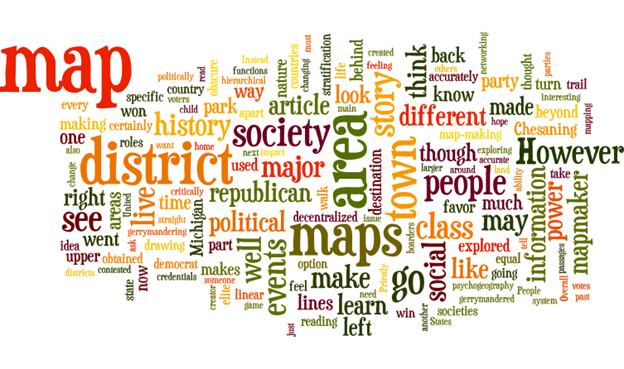
As you can see, my taxonomy and folksonomy are drastically different. Though they are related to similar topics, the information you retain from them is different. The first thing I noticed is the folksonomy overly highlights the mapping concept. The word map, maps, district, society, and area stand out the most. These ideas are all subsets of the concept of mapping. Moreover, if you look deeper into “the cloud” you can see the words information, power, history, credentials, and story. These words indicate that there is deeper information that relates to each of the main topics mentioned in the taxonomy. Specifically, they elaborate on the simple concepts in lines and mapping. Overall, the word cloud digs deeper into the information behind mapping and lines while the taxonomy looks at the surface of those same ideas.
I personally find the taxonomy easier to understand, especially if I want to retain information in a quick and easy way. However, I find the abstractness of the folksonomy more intriguing. It’s unique, fun, and a great way to look at deeper meanings behind surface-like concepts.
Taxonomies and folksonomies are certainly unique in their uses. Think about it, would you want your teacher to write out a study guide as a taxonomy or folksonomy? The taxonomy would clearly make more sense as it is easily understandable. However, you could use a folksonomy to build off the concepts in the taxonomy to help you better understand the material. I did the exact same thing in the creation of my taxonomy and folksonomy. The word cloud simply built off the ideas in the taxonomy in an abstract way!
I want to encourage each of you to try to create a taxonomy and folksonomy of something you organize in your everyday life! Who knows, maybe you’ll gain a deeper understanding of what you’re organizing and be able to apply it differently.
 Abby's Blog